Frequently Asked Questions
-
What is CHRP?
CHRP is a system that turns everyday music listening into emotional self-awareness. It helps people notice emotional drift early and adjust before performance, wellbeing, or resilience decline.Who is CHRP for?
CHRP is for people who want to understand themselves better and for organizations that want early, privacy-safe insight to support performance at scale.What problem does CHRP solve?
Performance and wellbeing usually break before systems notice. CHRP surfaces early emotional signals so people and teams can respond sooner.Is CHRP therapy or mental health treatment?
No. CHRP is not therapy, diagnosis, or clinical care. It is a self-awareness and performance tool designed to support emotional regulation before issues escalate. -
How does CHRP work day-to-day?
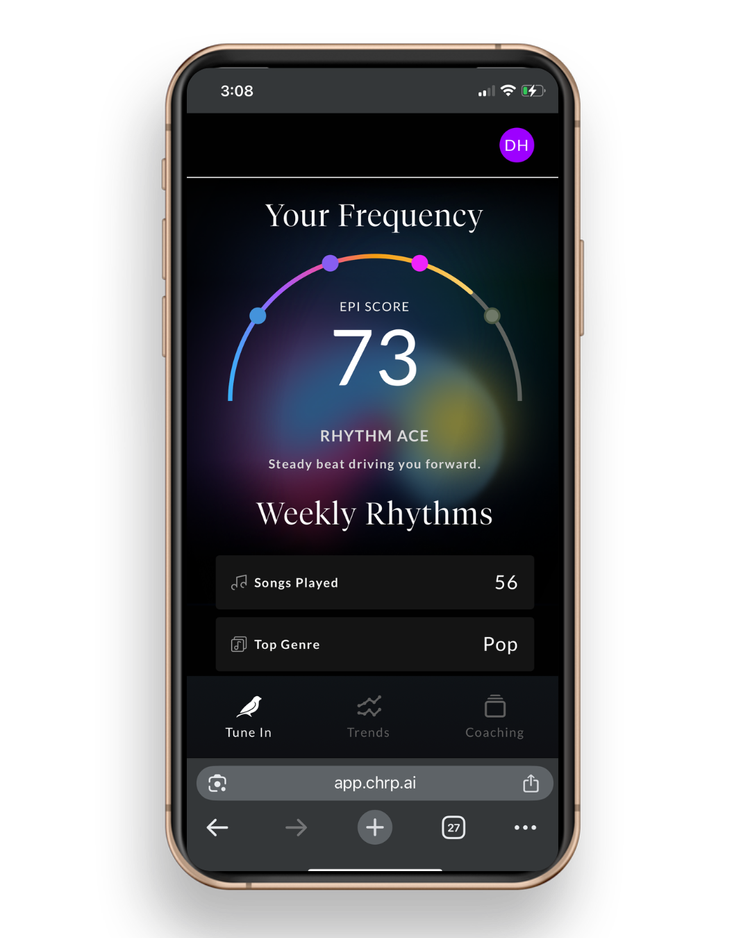
CHRP follows a simple path: connect your music, listen as you normally do, receive an EPI Score and insights, and adjust based on awareness. No surveys, check-ins, or extra effort required.What does CHRP actually measure?
CHRP measures five interconnected signals relative to your personal baseline: overall emotional readiness (EPI Score), motivation, balance, stress, and teamwork readiness.Why music?
Music is closely tied to emotion and regulation. Listening patterns often shift before people consciously notice changes in mood, energy, or stress.How much listening is needed for CHRP to work?
About 20–30 songs over a few days is enough to establish an initial baseline. Accuracy improves naturally over time.Does CHRP work if I listen to the same playlist all the time?
Yes. Familiar playlists create a stable baseline, and even subtle changes in how you engage with them can signal emotional shifts.What if my family uses a shared or family music plan?
CHRP only analyzes listening tied to your individual profile and device session. Other listeners on the plan do not affect your data.Can I game the system by only playing certain music?
Not really. CHRP looks at consistency, duration, repetition, timing, and diversity over time. Sustained behavior is harder to fake than to simply listen naturally. -
Does listening to sad music mean I’m sad?
No. CHRP looks at patterns over time, not individual songs. Context and repetition matter more than labels.Can CHRP detect stress or burnout?
Yes. Sustained shifts in energy, variability, and listening behavior can indicate early stress or burnout patterns.What happens if my score is low?
Nothing punitive. CHRP exists to inform, not judge. Low scores are signals for awareness and adjustment, not failure.Do I need to change how I listen to music?
No. CHRP works best when you listen naturally. Self-awareness drives change, not forced behavior.Is CHRP just a mood tracker?
No. CHRP reflects trends and patterns over time, not momentary emotions. -
How do organizations use CHRP?
Organizations use CHRP to detect team-level emotional drift early, before it impacts performance, retention, or readiness.What do leaders or managers see?
Only anonymized, aggregated trends across groups. They never see individual scores, identities, or music preferences.Is this workplace surveillance?
No. CHRP analyzes behavioral patterns, not content. It does not monitor communication, lyrics, or personal data, and individuals control participation.Can an employer force someone to use CHRP?
No. CHRP is opt-in. Organizations can offer access, but individuals choose whether to connect their music.What does a typical deployment look like?
Most deployments start across high-impact teams or divisions, aiming for 40–60% adoption within 90 days to reach meaningful insight at scale. -
Is my data private?
Yes. Individual emotional data is private by default and visible only to you.Does CHRP sell or share data?
No. CHRP does not sell data, run ads, or allow third-party access to personal emotional information.Can I delete my data?
Yes. You can delete your profile and data at any time. Deletions are permanent.Why is CHRP safe to deploy inside organizations?
Because privacy is structural, not promised. Individual data stays individual, and organizational insight only exists at scale. -
What is the science behind CHRP?
CHRP is grounded in decades of music psychology, affective science, and digital phenotyping, including established emotional models.How accurate is CHRP?
Current emotional state classification accuracy is approximately 84%, and precision improves as personal baselines strengthen.Has CHRP been validated?
CHRP applies validated scientific frameworks and is undergoing ongoing validation with academic and institutional partners.Why should I trust CHRP?
Because CHRP is built around self-awareness, consent, and human dignity. It exists to empower people, not monitor them. -
Where can I learn more about privacy and terms?Privacy Policy: https://chrp.ai/privacyTerms & Conditions: https://chrp.ai/terms
What if I have questions or need help?You can contact us anytime at support@chrp.ai.
SEE CHRP IN ACTION