
The Science
Music is a measurable performance signal.
A 139-study meta-analysis in exercise and sport found music measurably influences affect, arousal, motivation, and perceived exertion. CHRP turns that behavioral signal into private EPI Score™ insight — before practice, before competition, before the shift starts.
Research foundation
139 studies. 3,599 participants. One consistent finding: music works.
A meta-analytic review in Psychological Bulletin (2020) found that music was associated with improved affective valence, physical performance, perceived exertion, and oxygen consumption in exercise and sport contexts. CHRP is built on this foundation — not wellness trends.
Terry, Karageorghis, Curran, Martin & Parsons-Smith (2020). Psychological Bulletin, 146(2). DOI: https://doi.org/10.1037/bul0000216
139
peer-reviewed studies
3,599
research participants
4
domains measured: affect, performance, perceived exertion, oxygen consumption
How music works on performance
Affect
Music is associated with shifts in emotional valence during exercise. Listeners tend to self-select music that matches or supports their target emotional state before and during physical activity.
Arousal
Tempo, rhythm, and dynamic range are associated with changes in physiological arousal in exercise contexts. High-tempo tracks are consistently linked with elevated readiness states prior to performance.
Motivation
Motivational music is associated with increased persistence and effort output in physical performance tasks. The meta-analytic evidence is grounded in exercise and sport contexts.
Perceived Exertion
Music is associated with reduced perception of effort during physical activity. Athletes who listen during training report lower perceived exertion at equivalent output levels.
The personalization signal
What you actually play is the signal.
Research shows that preferred, self-selected music produces stronger individual responses than imposed music. Music listening behavior is intentional, personal, and continuous — which makes it a meaningful behavioral signal that doesn't require a survey or wearable to capture.
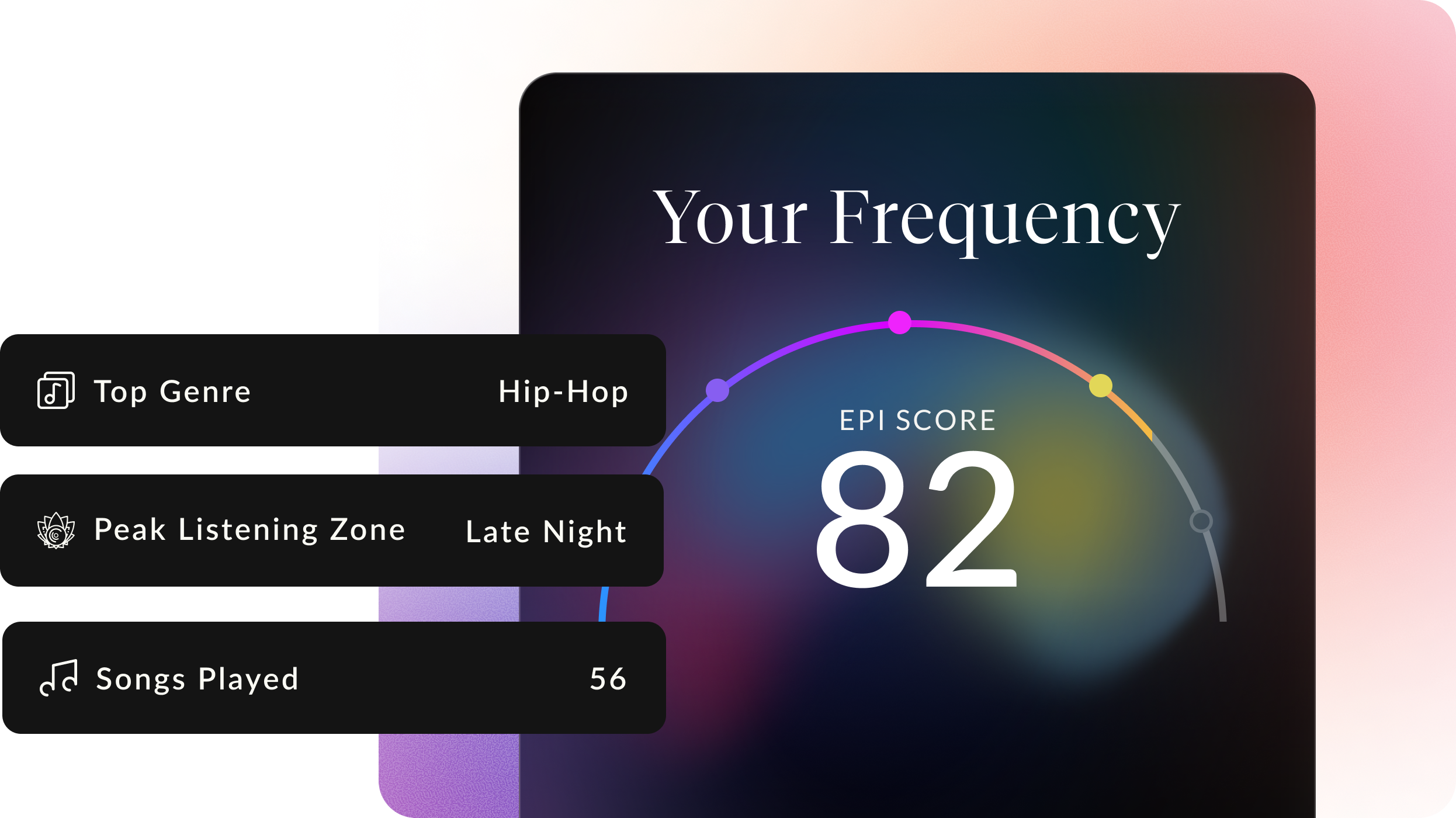
CHRP reads your actual listening behavior from Apple Music and Spotify — not a generic playlist — to generate your EPI Score™.
No surveys. No wearables. No new behavior required.
Five EPI dimensions
The EPI flywheel
Your music shapes how you move. CHRP® helps you use it with intention.
Data approach
Behavioral signal, not self-report.
CHRP does not ask how you feel. It reads how you listen. Music interaction patterns — over time, context, sequence, repetition, and deviation from your personal baseline — carry a meaningful behavioral signal. EPI Score™ is derived from that signal, not from surveys, check-ins, or self-report.
In organizational contexts, individuals always see their own EPI first. Organizations receive only anonymous aggregate trends — never individual data. This is a structural design property, not a policy setting.
What CHRP reads
Your music listening behavior from Apple Music or Spotify — what you play, when you play it, in what context, in what sequence.
What CHRP generates
An EPI Score™ — a weekly measure of your emotional performance state across five dimensions: Energy, Focus, Balance, Motivation, Stress.
What organizations receive
Anonymous aggregate trends only. No individual data. No names, no personal scores, no identification.
What CHRP is
A behavioral signal layer for readiness, regulation, and performance.
A private tool for individuals — built from their own music listening behavior.
An anonymous aggregate trend layer for leaders — individual data never shared.
Built on peer-reviewed research documenting music's measurable effects on performance.
What CHRP is not
CHRP does not diagnose medical or psychological conditions.
CHRP does not determine fitness for duty or employment decisions.
CHRP does not infer precise emotional states with clinical-grade accuracy.
CHRP is not a substitute for licensed clinical, psychological, or medical evaluation.
CHRP does not guarantee specific performance outcomes.
Foundational Research
The thinking behind CHRP is documented.
CHRP is built on peer-reviewed research. The foundational documents are available to qualified program leads, researchers, and institutional partners. Schedule a conversation to request access.
Research Summary
Concise summary of the foundational science — mechanisms, evidence quality, and practical application for performance environments.
Request access →Literature Overview
Overview of the 139-study meta-analysis in exercise and sport: scope, methodology, populations, and implications for behavioral performance systems.
Request access →EPI Model Brief
Technical brief on the EPI Score™ framework — five dimensions, signal derivation, privacy architecture, and organizational deployment.
Request access →See the science in action.
No surveys. No wearables. EPI Score™ is immediate on first connect and refreshes every week.